


You finish a hard session feeling great. A few hours later, you're flat. Your legs feel heavy, your energy is gone, and that night you lie awake, tired but wired. Some fatigue after training is part of the deal. A crash that takes over the rest of your day isn't something you have to just accept.
In this blog, you'll see how cortisol and athletic recovery are connected, why deep sleep matters so much, how to lower cortisol after a workout, and where a performance mouthpiece fits into your recovery.
What Cortisol Does During and After Training
Cortisol helps you get through a hard session. The trouble starts when it doesn't come back down afterward.
Cortisol is a stress hormone. When you train hard, your body releases more of it to free up energy and keep you sharp. That's normal, and it's useful.
Think of it like a gas pedal. You want your foot down during the session, then off once you're done, so your body can switch from "go" mode into repair mode.
|
Phase |
What cortisol is doing |
How it often feels |
|---|---|---|
|
During your session |
Freeing up energy for the effort |
Focused and locked in |
|
After a good recovery |
Dropping back down so repair can begin |
Tired, but in a good way |
|
When it stays high |
Keeping your body in "go" mode |
Flat, wired, and slow to bounce back |
That last row is the crash. It's also the part you can do something about.
Why Your Post-Workout Crash Happens
A crash rarely comes from one thing. It's usually a few habits stacking up and keeping cortisol higher than it needs to be:
-
Hard sessions back to back: Your body never gets a full chance to reset between them.
-
Training on an empty tank: Skipping food before or after a session adds stress on top of stress.
-
Late, intense workouts: A hard evening session can leave you wired at bedtime.
-
Short or broken sleep: Less sleep means less time for your body to recover.
-
Everyday stress: Work, school, and family all add to the same total.
The fix usually isn't giving up hard training. It's helping your body switch off faster once the work is done.
Deep Sleep and Muscle Recovery: Where the Real Repair Happens
Deep sleep is when your body does a lot of its physical repair. When cortisol stays high into the evening, it's harder to get there.
Cortisol follows a daily rhythm. It's higher in the morning and lowest at night. When a late session or a stressful day keeps it up, falling asleep gets harder, and a rough night can leave you starting tomorrow already behind. Better sleep helps break that loop.
Keep Your Airway Clear Through the Night
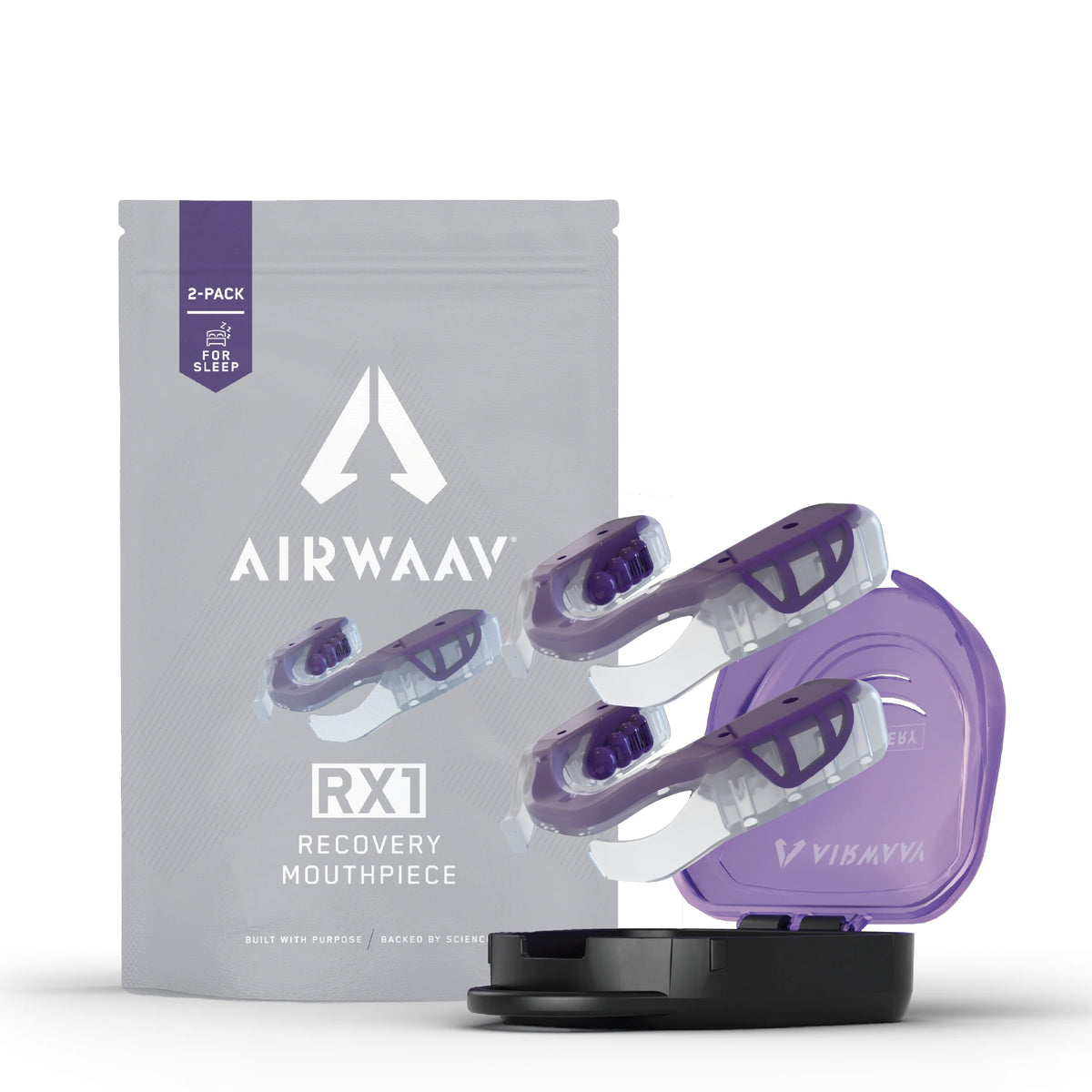
Deep, steady sleep starts with steady breathing. The AIRWAAV RX1 Recovery Mouthpiece clears your airway without jaw repositioning. Its patented Reflex Technology™ uses Reflex Bumps that contact the base of your tongue and trigger a subconscious reflex that moves it forward.
Add Nasal Strips, whose enhanced adhesive holds through 8–10 hours of wear, to support nasal breathing all night.
Want to cover the other side of recovery too? Pro Sleep is a melatonin-free recovery supplement made with Magnesium Bisglycinate, L-Theanine, GABA, Glycine, Reishi Mushroom, and NAC. RX1 handles the airway, and Pro Sleep handles the biochemistry. Together with Nasal Strips, they make up the Sleep System.
How to Lower Cortisol After a Workout
The goal is to give your body a clear signal that the work is over. These simple habits help:
-
Cool down: Spend a few easy minutes walking, spinning, or stretching before you stop completely.
-
Slow your breathing: Long, easy breaths through your nose help you shift out of "go" mode.
-
Refuel and rehydrate: Eat a mix of carbs and protein, and replace the fluid you sweated out.
-
Watch late caffeine: A pre-workout at 7 p.m. can follow you to bed.
-
Plan easy days: Hard training works best with lighter days built in.
You can also start working on recovery before the session ends. The AIRWAAV Performance Mouthpiece is built around three benefits:
-
Breathe better to endure longer: AIRWAAV lowers respiratory rate by up to 20% (peer-reviewed), and its design helps position your jaw to open your airway.
-
Clench stronger to perform better: The patented bite plate positions your jaw, so when you clench, it activates a neuromuscular response that engages more muscles and helps unlock more strength.
-
Stay calm to recover faster: AIRWAAV reduces post-exercise cortisol by up to 50% (peer-reviewed).
Put all three together, and you get an accessory that works during your sets and after them. It's built on 15+ years of peer-reviewed research, developed in collaboration with Dr. Dena Garner, a researcher in muscle physiology and airway performance.
Choose PX1 for a relaxed, barely-there fit, PX2 for a snug, locked-in fit, or the Performance Hybrid Pack to try both. The benefits are the same either way.


Can You Reduce Lactic Acid During a Workout?
You can't switch it off, but you can manage the burn.
That burn on a hard set or a tough interval comes from your body making energy fast. Your body clears it fairly quickly once you ease off, and it isn't the main reason you're sore two days later. To keep the burn in check while you train:
-
Warm up properly: Ease into the hard work instead of starting cold.
-
Pace yourself: Going out too hot builds the burn faster.
-
Rest between sets: Short breaks give your body time to catch up.
-
Keep your breathing steady: Calm, controlled breaths help you hold your pace.
Steady breathing is where the Performance Mouthpiece earns its spot. Pair it with Nasal Strips, and you've got the Performance System, a dual-airway advantage in training.
FAQs
Is cortisol bad for athletes?
No. Cortisol helps fuel hard training. It only gets in the way of recovery when it stays high long after you're done.
Does a performance mouthpiece help with recovery?
AIRWAAV reduces post-exercise cortisol by up to 50% (peer-reviewed). Cortisol is a stress hormone, and that's the science behind the "recover faster" part.
What's the difference between the Performance Mouthpiece and RX1?
The Performance Mouthpiece is for training. RX1 is for sleep, and it clears your airway without jaw repositioning.
Does lactic acid cause next-day soreness?
Not mainly. Your body clears it fairly quickly after you stop. Next-day soreness has more to do with your muscles repairing after hard work.
Can I use my HSA or FSA?
Yes. AIRWAAV is HSA/FSA eligible.
Recover From Every Session With AIRWAAV
Cortisol isn't the enemy. It's what helps you push through hard training. Recovery starts when it comes back down, and that depends on how you cool down, refuel, breathe, and sleep. Get those right, and the post-workout crash becomes much easier to avoid.
AIRWAAV supports both ends of your day: the Performance Mouthpiece during training, and RX1, Nasal Strips, and Pro Sleep at night.
Ready to build your recovery routine? Shop AIRWAAV bundles.